This extremely elusive Leucistic Red-tailed Hawk was caught off guard while I finally got to take aim at semi-close range. It always flushes, but not too quick today! I love his wing pattern which seems so symetrical for a leucy...
NOTE: Alot of us locals know about the leucistic red-tailed hawk ("Whitey") in Channahon IL which has been photo'd by many. This one is about 20-ish miles from him.
Leucism is a condition characterized by reduced pigmentation in animals. Unlike albinism, it is caused by a reduction in all types of skin pigment, not just melanin.
I finally got my close encounter with a resident Pileated Woodpecker in my neck of the woods. I was watching Yellow-bellied Sapsuckers work some trees when this gal silently flew in to inspect this tree. Lucky for me I saw her sneak into a cavity, so then I waited for her to come out and here is the shot!
The Pileated Woodpecker is one of the biggest, most striking forest birds on the continent. It’s nearly the size of a crow, black with bold white stripes down the neck and a flaming-red crest. Look (and listen) for Pileated Woodpeckers whacking at dead trees and fallen logs in search of their main prey, carpenter ants, leaving unique rectangular holes in the wood. The nest holes these birds make offer crucial shelter to many species including swifts, owls, ducks, bats, and pine martens.
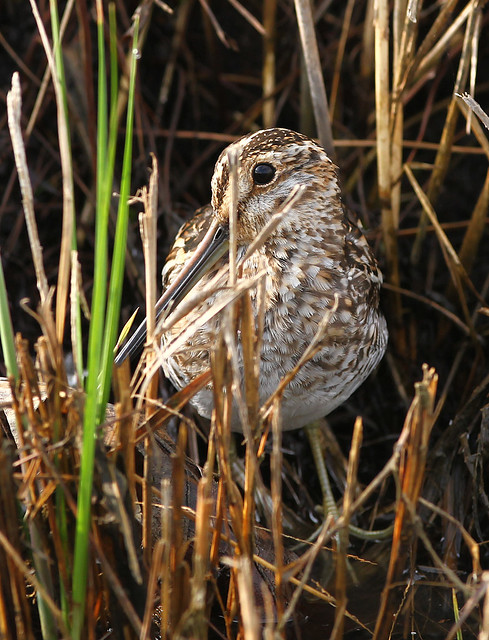
The snipe is part of the wader family Scolopacidae. The 15 typical snipes in the genus Gallinago are the closest relatives of the woodcocks.
Snipe search for invertebrates in the mud with a "sewing-machine" action of their long bills. The sensitiveness of the bill, though to some extent noticeable in many sandpipers, is in snipes carried to an extreme by a number of filaments, belonging to the fifth pair of nerves, which run almost to the tip and open immediately under the soft cuticle in a series of cells. They give this portion of the surface of the premaxillaries, when exposed, a honeycomb-like appearance. Thus the bill becomes a most delicate organ of sensation, and by its means the bird, while probing for food, is at once able to distinguish the nature of the objects it encounters, though these are wholly out of sight.
For the truly gullible:
A snipe hunt, a form of wild-goose chase that is also known as a fool's errand, is a type of practical joke that involves experienced people making fun of credulous newcomers by giving them an impossible or imaginary task. The origin of the term is a practical joke where inexperienced campers are told about a bird or animal called the snipe as well as a usually preposterous method of catching it, such as running around the woods carrying a bag or making strange noises such as banging rocks together. Incidentally, the snipe (a family of shorebirds) is difficult to catch for experienced hunters, so much so that the word "sniper" is derived from it to refer to anyone skilled enough to shoot one.
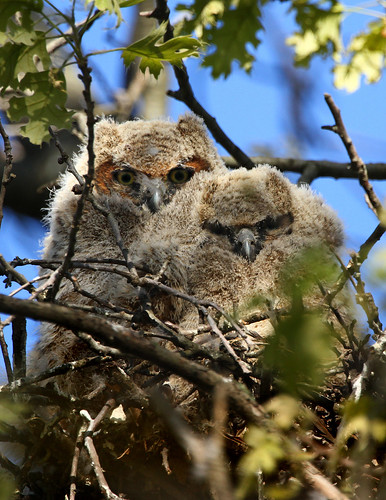
These past few weeks have been terrific for owling! I have never had this much luck finding owls until this amazing year. They are everywhere! Barred, Great-horned, Short-eared, Long-eared, and snowys! (Still need a Saw-whet though...) Lucky for me owls are my favorites and I get to enjoy them all winter long--hopefully!
I owe this find to my good friend Rattlinantler. Click here for his site!
Click on any photo for a better larger view of entire set of photos!
I had to create a post for my birthday, and what better a subject than the extremely rare Whooping Crane(s). Nine of these creatures flew in for a restover and have stayed for more than a week now, waiting for favorable southerly winds to retake the skies. (Note: These birds are NOT the juveniles that have already migrated with the help of Operation Migrations ultralight airplanes this year. They are migrating on their own.)
Did you know that there are only 105 whooping cranes east of the Mississippi River? And here I am lucky enough to put my lens on these 9!
They are clearly banded, and with some research I have found out that these guys are from the 2009 hatch at Necedah Wisconsin's Operation Migration. Here is what they said in 2009: "On July 21, 2009, 11 Whooping Crane chicks were transferred from ICF to the nearb Necedah National Wildlife Refuge (NWR) to make up the 2009 Direct Autumn Release (DAR) cohort. The DAR birds are initially isolation-reared at ICF and then at the Necedah NWR until the fall. All the chicks were wary of all the new sounds of bird life in the marsh, but adjusted well to the beauty of nature on the refuge. In September or October they are released on or near the refuge with older Whooping Cranes and Sandhill Cranes, from whom they learn the migration route."
(Best photo to view large! Check out the expressions on these guys tiffing!)
It is beyond comprehension how to feel knowing I am standing before these 9 birds and knowing that I am looking at just about 10% of the eastern population. I also found out that whooping cranes are 2nd on the top 10 endangered species list.
In 1937, fewer than 20 birds remained, all in a population that wintered in Texas.
Today, with efforts made to stop these beautiful creatures from becoming extinct,
there are about 400+ in the wild.
Bald Eagles are hanging out at the local dam again. A sure sign of cold weather!
Northern Mockingbird. A rare sighting in these parts and a possible wintering bird? I hope so!
Northern Shrike. Another infrequent visitor and another possible wintering bird? These both were found just a few hundred feet from eachother. Double whammy!
And last but not least: Groundhog, Whistlepig, Woodchuck, etc. He's definately a juvy and too friendly for his own good. Good luck buddy!