Showing posts with label common snipe. Show all posts

Friday, March 23, 2012

Snipe Hunting: The REAL Snipe and the Joke....

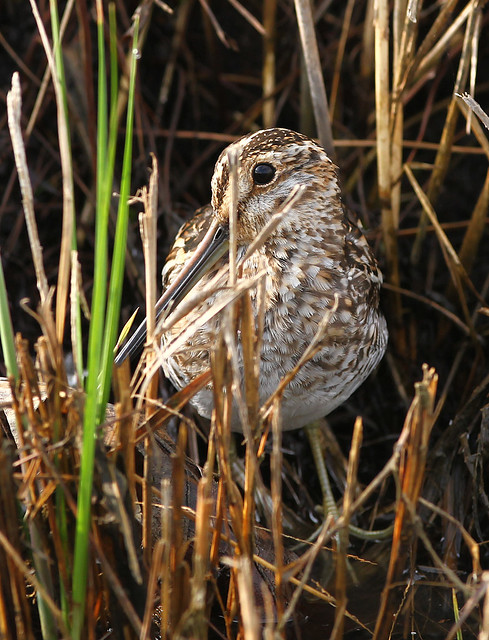
Wilsons Snipe

snipe br lk 2   3-12

The snipe is part of the wader family Scolopacidae. The 15 typical snipes in the genus Gallinago are the closest relatives of the woodcocks.

Snipe search for invertebrates in the mud with a "sewing-machine" action of their long bills. The sensitiveness of the bill, though to some extent noticeable in many sandpipers, is in snipes carried to an extreme by a number of filaments, belonging to the fifth pair of nerves, which run almost to the tip and open immediately under the soft cuticle in a series of cells. They give this portion of the surface of the premaxillaries, when exposed, a honeycomb-like appearance. Thus the bill becomes a most delicate organ of sensation, and by its means the bird, while probing for food, is at once able to distinguish the nature of the objects it encounters, though these are wholly out of sight.

For the truly gullible:

A snipe hunt, a form of wild-goose chase that is also known as a fool's errand, is a type of practical joke that involves experienced people making fun of credulous newcomers by giving them an impossible or imaginary task. The origin of the term is a practical joke where inexperienced campers are told about a bird or animal called the snipe as well as a usually preposterous method of catching it, such as running around the woods carrying a bag or making strange noises such as banging rocks together. Incidentally, the snipe (a family of shorebirds) is difficult to catch for experienced hunters, so much so that the word "sniper" is derived from it to refer to anyone skilled enough to shoot one.

Monday, April 12, 2010

Sky Goat

This well camouflaged bird is usually shy and conceals itself close to ground vegetation and flushes only when approached closely. They fly off in a series of aerial zig-zags to confuse predators. Snipe hunters, therefore, needed to be very skilled to hunt these birds and they came to be called snipers, a term later adopted by the military. These birds forage in soft mud, probing or picking up food by sight. They mainly eat insects and earthworms, also plant material.
The male performs "winnowing" display during courtship, flying high in circles and then taking shallow dives to produce a distinctive sound, which has given the bird its Finnish name taivaanvuohi, "sky goat", because the sound is similar to the baaing of a goat. Common Snipe nest in a well-hidden location on the ground.
(Source: Wikipedia)


Thursday, April 8, 2010

Snipe Drumming

Shooting the camera between raindrops yesterday, the sky was filled with the sounds of Snipe. I sat in the parking lot at Goose Lake Prairie as the rain gently came in and the Snipe took to the air for their aerial display. During breeding season, they first fly up high and then plunge downward vibrating their outer tail feathers (As seen in the photos) to produce a curious whirring sound called drumming.

Note: Although the photography isn't of good quality, I couldn't put the camera down, as I was addicted to the moment. I saw at least a dozen performing and lots of chasing. I also heard a Wilson's Snipe, but couldn't find it.


Wednesday, March 31, 2010

Flight Shots

It was a pretty windy day at Goose Lake Prairie yesterday, so I didn't expect to find much, but what I did find were a few species in the air. I found Killdeer, Tree Swallows and a Snipe!


I call these guys "Flying Orca's". Is it just me or do they look like a mini Killer Whale?


Common Snipe

Tuesday, April 7, 2009

Breathing Room

Hi Bloggy Buddies, it's me Hannibal! I know... I've been out of the loop for quite a while but I have a list of excuses! New puppy duties, magazine deadline duties, broken camera lens sickness, new computer systems to learn, etc, etc...

But now that I am back into the swing of things and my favorite lens has been put back into my hands...

I bring to you...

Snipes! (Thanks to Rattlin Antler for the snipe location tip!)


Tuesday, October 7, 2008

Goose Lake Menagerie

The last of the latest in Goose Lake!


The Cabin is hard NOT to photograph, as I have shot 100's of frames.


The sunrise in the tall grass is also a fav of mine.


The geese are always around, so a take off shot is irresistible.


The Palm Warbler is the most abundant migrater at the prairie.


The snipe can sometimes be caught flying in the morning, just after the fog has burnt off.

Saturday, August 30, 2008

Goose Lake Odds N Ends


This windmill was just erected this past month. It will serve as a waterpump to keep the nearby lake from drying up. The covered wagon adds some nostagia to this prairie.


This female Red-winged Blackbird was glowing in the morning light.


I haven't seen the Common Snipe since May, so hearing their call as a flock scattered to another wet area was really cool. I wasn't sure of what the strange noises were until I checked my camera display alittle closer.


The Solitary Sandpiper was a first for me. It's a species commonly found at Goose Lake (along with the Henslow Sparrow).

Wednesday, April 23, 2008

The Flight Display of the Common Snipe

I went out to Goose Lake Prairie State Park to capture some Tree Swallow shots, and set up near a birdhouse. I was taking plenty of photos of them, and suddenly heard a weird sound. I didn't know what it was, and couldn't zero in on a location, but it was definately close. It sounded like a monkey call if I had to describe it. Every time I heard it, it seemed to ride the wind. I attempted to get closer to where the sound was coming from, but just as I go in 1 direction, it seemed to be behind me. My partner Cutti pointed into the sky and saw the bird that was making the noise. I knew right away it was a Snipe or a Woodcock doing their aerial display. (After referencing my field guide, it was determined that snipes were displaying.)


Beautifully striped with a very long beak, these waders nest in dense vegetation and tend only to be seen when accidentally put to flight. That is unless their display flight is witnessed. During the breeding season, snipe display above the pastures in which they breed & Goose Lake Prairie is a prime example of excellent habitat. They first fly up high and then plunge downward vibrating their outer tail feathers to produce a curious whirring sound, called drumming.


To watch this display in action is amazing...Watching the sky when a bunch are up there is awesome...


It is so weird that the sound they make comes from their feathers vibrating instead of their throats.


The snipe flight behavior reminds me of aerial combat maneuvers of a fighter jet.


(These last 2 photos were taken 2 years ago, because I did not get any ground shots on this day.)

* Also known as Wilson's Snipe