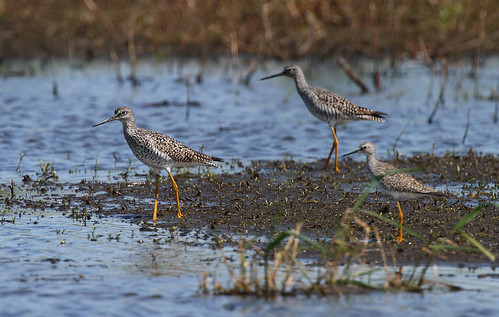
Greater Yellowlegs migrating through southeastern Grundy County at a corn stubble fluddle

Showing posts with label greater yellowlegs. Show all posts
Showing posts with label greater yellowlegs. Show all posts
Tuesday, April 27, 2010


Friday, August 7, 2009
Assorted Peeps
Over the past few months, I have been checking a local fluddle that seems to never dry up. I've saved a few photos to post about when all is said and done, and the fluddle has dried up. That day is today. It enticed many types of peeps, but getting good photos was a whole other story. It was a tough shot at any time of day, but I managed a few that were blog-worthy. I also want to note that identifying these waders was very tough, so if you want to argue an ID, please do!

Least Sandpiper (?)

Long-billed Dowitcher

Greater Yellowlegs

Least Sandpipers(?) landing

An assortment of peeps including Greater Yellowlegs, Killdeer, and last but not least, mystery peeps. The smallest peeps in this scene I cannot ID. Can you?

Least Sandpiper (?)

Long-billed Dowitcher

Greater Yellowlegs

Least Sandpipers(?) landing

An assortment of peeps including Greater Yellowlegs, Killdeer, and last but not least, mystery peeps. The smallest peeps in this scene I cannot ID. Can you?
Wednesday, May 20, 2009
Wading in the Sunset
 While on vacation, expecting nothing better than great things, my choice of weeks, weather wise, came up a bit short. It's a good thing I chose to stay around home for the entire week, or it could have been a huge spoiler. Anyway,it was a nice sunset to shoot these Greater Yellowlegs!
There were hundreds of waders, most were yellowlegs and willets.

Don't expect me to know the difference in this lighting!
 As the day ended, the flock flew off into the sunset!
Tuesday, July 22, 2008
Goose Lake Flora and Fauna
Going to the marsh every day led to plenty of interesting photos along the way.

Black-eyed Susans are a common prairie plant, giving color to the tall grass palette.

Another "lifebird" for me, the Orchard Oriole couple gave clues to their presence with their song. Thanks to Bird Girl for mentioning that these are immatures &/or females!

The Marsh Wren, another "lifer", was singing at the marsh where the bitterns resided.

The Geese flew in to the first lake that you encounter at the beginning of the trails.

In the heart of the prairie, Cragg Cabin can be viewed in the distance.

As the sun rose, the geese woke up and flew to a new location for breakfast.

Another "lifer", Greater Yellowlegs fished the shoreline.

This particular one caught a bullfrog!

The landing gear is down, please put your seats in their upright positions...

On a foggy wet morning, the cabin can take on a different look, which made for a nice monochrome.

On our path to the marsh, "Ridge" found some honey bees making a branch their temporary home, while the scouts looked for a new site.

We learned later, that when bees congregate in a tree with no hive, it's because their old home was most likely destroyed, so they wait patiently (up to 24 hours), until the scouts select a new site to be built.

They were gone by that evening.

Not knowing a thing about either the plant or the winged insect, I labeled this photo butterfly plant. I do not even know if it is a butterfly. But...there were hundreds of these white winged creatures all over plants like this.

Black-eyed Susans are a common prairie plant, giving color to the tall grass palette.

Another "lifebird" for me, the Orchard Oriole couple gave clues to their presence with their song. Thanks to Bird Girl for mentioning that these are immatures &/or females!

The Marsh Wren, another "lifer", was singing at the marsh where the bitterns resided.

The Geese flew in to the first lake that you encounter at the beginning of the trails.

In the heart of the prairie, Cragg Cabin can be viewed in the distance.

As the sun rose, the geese woke up and flew to a new location for breakfast.

Another "lifer", Greater Yellowlegs fished the shoreline.

This particular one caught a bullfrog!

The landing gear is down, please put your seats in their upright positions...

On a foggy wet morning, the cabin can take on a different look, which made for a nice monochrome.

On our path to the marsh, "Ridge" found some honey bees making a branch their temporary home, while the scouts looked for a new site.

We learned later, that when bees congregate in a tree with no hive, it's because their old home was most likely destroyed, so they wait patiently (up to 24 hours), until the scouts select a new site to be built.

They were gone by that evening.

Not knowing a thing about either the plant or the winged insect, I labeled this photo butterfly plant. I do not even know if it is a butterfly. But...there were hundreds of these white winged creatures all over plants like this.
Subscribe to:
Posts (Atom)