Showing posts with label short eared owl. Show all posts

Tuesday, March 26, 2013

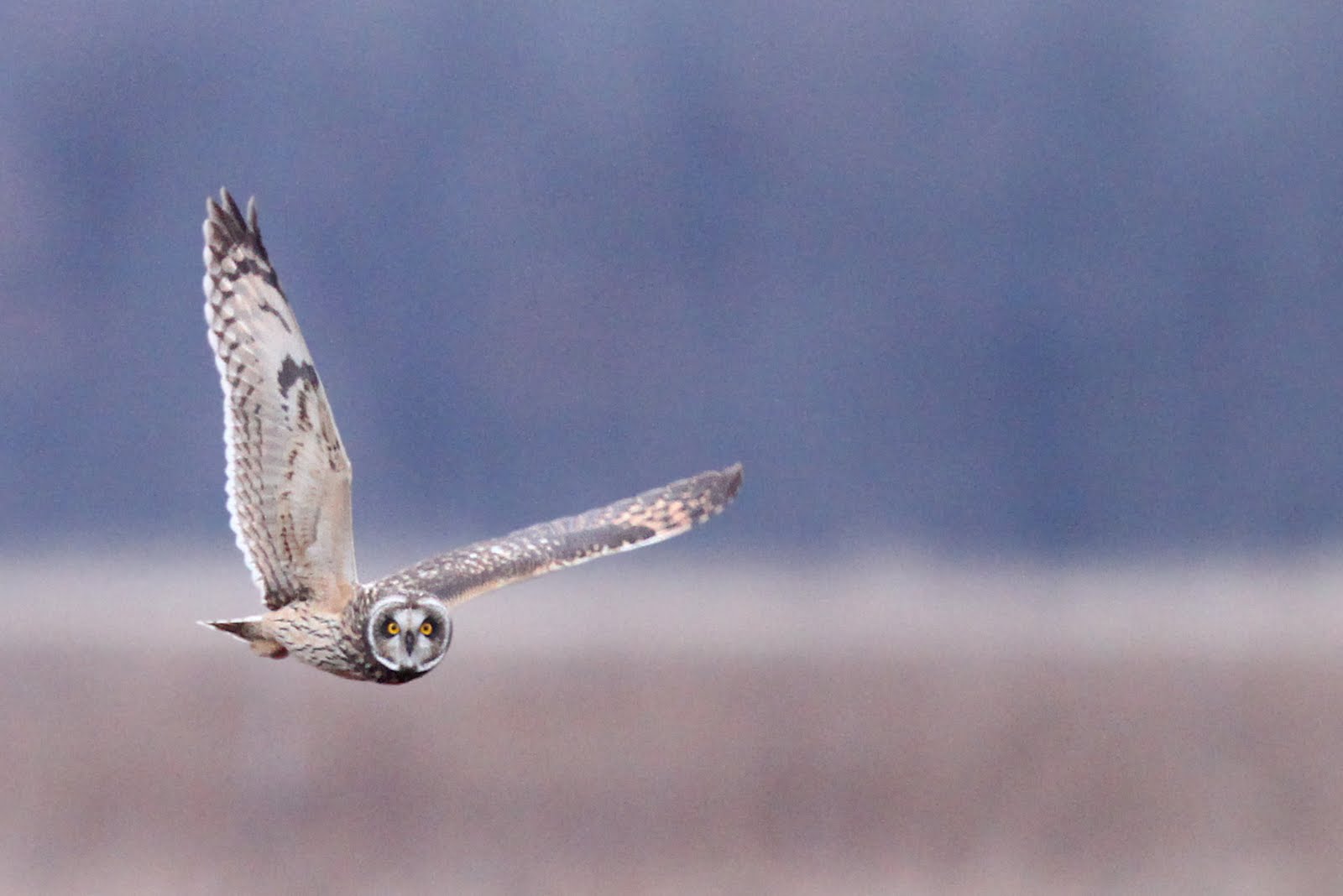
Up Close & Personal with 4 Short-eared Owls

I got another hot tip! Short-eared Owls that day roost in an agricultural ditch and are highly tolerant of cars stopping. So I get my directions and journey 130 miles to the location. Finding the owls along the tall grasses with their amazing camouflaged feathers was pretty frustrating at first, but once you spot the first one, you know exactly how to find more. Yep, there they were, just sitting & waiting for me to show up. The morning was extremely windy and these little fellas knew exactly how to pick excellent cover to break the blow. There were plenty of grassy "caves" to hide out in. Thanks guys! You made my day!


Wednesday, February 29, 2012

Long-eared Owl

As I posted previously, this Long-eared Owl was just 2 trees away from the Barn Owl.


The area it is in is a "honey hole" for owls because in the same woods, there has been Long-eared's, Saw Whet, Barn and a Great-horned Owl. In the field adjacent to the woods are 12 Short-eared Owls. AMAZING!!!!!! All at the same time, sharing the same location. FIVE DIFFERENT SPECIES OF OWLS!


Admittedly, these are not my best shots of LEO's, but I posted them anyway...

Monday, January 9, 2012

Some more Short-eared Owl Images

I've been concentrating on wintering owls lately and these Short-eared Owls are the toughest to nail. They come out at dusk, so a very high ISO is necessary to get any "clean" images. "Clean" is a bit of an oxymoron as higher ISO's make for a very "dirty" image. Lets break this down a little further for those of you who don't necessarily understand: See, when you boost the sensitivity of your image sensor by selecting a higher ISO, the image sensor is now able to record a fainter light signal. In my case: dusk. However, it is also true now that it will record fainter noise, where noise is any signal that is not attributed to the light from your subject. The increased sensitivity allows the image sensor to record more light signal and more noise. Shooting moving objects (in less-than-sunny skies) also requires a higher ISO so that your shutter speed is faster to freeze the motion.
Hope that makes sense...


This was my best shot. Luckily he was close enough to shoot at 300mm. but the ISO was way up there at ISO 2000. I NEVER shoot that high!


There were quite a few owls out, and they favored these poles to sit on, claiming temporary territories for their dinnertime activities.


This fella was captured "barking" his claim to his territory. Barking is the term used for Short-eared Owl calls. (click on this one to see mouth open)


Tuesday, January 3, 2012

Short-eared Owls

Let me preface this post with stating that these shots are not up to my standards, but given the subject matter and the gas/time spent attempting these shots, I am posting them anyway.

I was so excited to shoot these guys on a trip I took this weekend. I went to Nashville for a concert and thought on my way back I could get some birding in. A new friend of mine gave me directions to such a rare bird of prey that fit into my schedule perfectly. I found the location and waited...


I waited for quite some time, circling the area until the show began...
And when I say the show began, I mean "WHOA!!!! They flew out from every direction!
As you see in these shots, plenty went wrong in all of about 10 minutes of showtime.


My aperture was off, my dial was misaligned to manual and I had the 2x on for closer shots. Everything that could go wrong, DID!


The owl even landed for a brief moment in which I found opportunity to whip off the 2x, shoot straight 300 and of course, the aperture was on 6.3. The shutter lagged so much that the exposure was 1/20th sec at twilight! I felt like Charlie Brown...


I managed a few shots at 1/400 with the 300mm before calling it quits with the light draining to impossible...


There was nothing I could do to fix it now, so enjoying the show with my own eyes not behind a few pieces of expensive glass was thrilling none-the-less.


Now that the night was here, all I have been able to think about was how it all went horribly wrong and what I am going to do right, next time...

Monday, November 26, 2007

My Owl Mission Part 1-Short Eared Owls


Tis the season for owl hunting, if you are into that kind of thing, and I am! I can't wait for my first one of the winter season. There are many species of "owl" to seek in these parts. For instance, Part 1 of this series is: Short Eared Owls. SEO's are on the endangered species list. They are a medium sized rapter you can find in open fields soaring and hunting rodents, mainly in the winter months, acting alot like hawks, more specifically, the Northern Harrier. Their ear tufts are short, thus their given name. Their call is alot like the bark of a dog. It is sharp and high, like that of a "yippie" toy breed. They are not your typical "hoot" owl. You won't generally stumble upon them roosting, as most owls, although I have tried once, when I saw one land on a lower branch way off in the distance (it flushed as I approached). You mainly have to rely on the skies for spotting them. They compete with Harriers for food and territory, and I have witnessed the combats and aerial displays. I got my first shots of these guys last year at Goose Lake Prairie State Park. It wasn't a fun venture. When you prepare for this outing, expect alot of bone-chilling wind, along with deep-freezing temperatures. The trek into our "arctic" involves a complete lack of vanity. The knit hat, gloves, ear muffs, scarf, boots, tripod, your camera stuffed inside your coat, and lots of kleenex and patience makes for an uncomfortable few hours. Setting up for them isn't easy either. Short-Eareds are diurnal, but become most active at dusk. You have to deal with longer shutter speeds and tricky lighting. If you are lucky, the light will be enough to capture them as they fly without too much blur. The pictures above are a few I got last year, but as you can see, nothing worth much more than proof of their identity. The top photo is a "google image" of what they look like up close. Also, expect frustration, because with the waiting in the "tundra", its not a sure thing that they will be in your part of that tundra, for a shot. I spent plenty of evenings in the bitter extremes without taking a single shot. Is it worth it? It must be, because I am looking forward to that day I see them again, even in my "arctic frock", and of course, the pursuit for better shots of my favorite species, the owl.

Coming soon in this series: Long-Eared Owls, Snowy's, Saw-Whets, Screech's, Barred, Barn, and Great Horned.